
Who We Are
We are a dedicated team of experienced Gas Safe registered engineers committed to providing the highest-quality gas engineer training and services. Our programs combine both theoretical knowledge and hands-on experience, including boiler installation training, gas portfolio training, and new boiler installer courses, ensuring that new entrants and career changers receive comprehensive instruction. Our trainees gain practical skills through hands-on gas portfolio sessions covering boiler repair, boiler fault finding, emergency boiler service, expert boiler repair techniques, and boiler diagnostics. We also teach essential aspects of heating system service, boiler maintenance, and how to fix boiler issues safely and effectively.
Beyond boilers, our expert trainers guide students through gas cooker installation, kitchen appliance installation, professional gas fitting, and safe gas appliance fitting procedures. By training under certified Gas Safe engineers, students not only acquire the technical expertise required to become fully qualified heating engineers but also develop the confidence to handle real-world scenarios. Each placement is designed to provide a robust foundation, preparing learners for ACS certification and full Gas Safe registration while instilling industry best practices and professional standards.
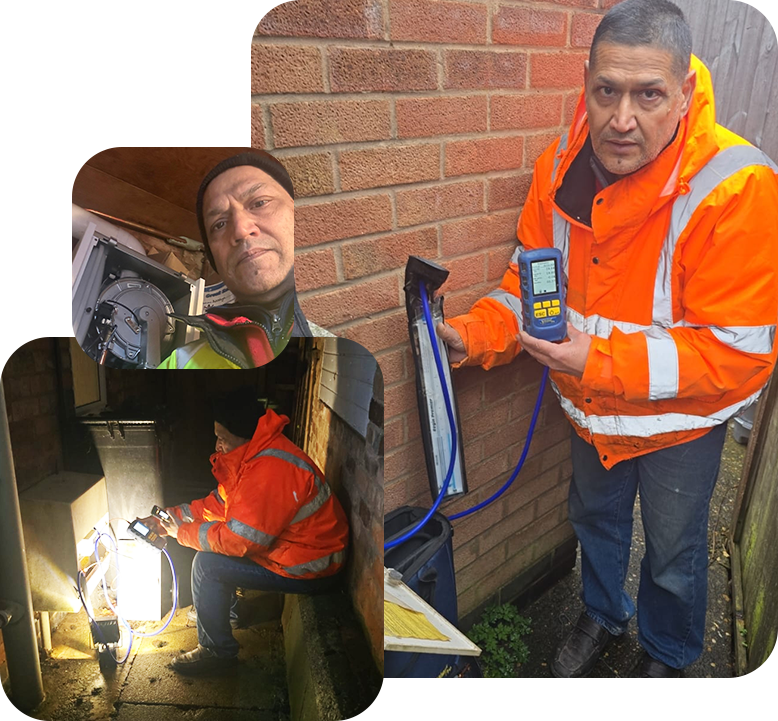
Installation Write-Up Checklist
Tools list :
Spanner, manometer/U-gauge, screwdriver, heat lamp, flux, pipe cutter, PPE (e.g. steel-capped boots, gloves), spirit level.
Visual inspection :
Look for unsafe conditions.
Preparation of the work area :
Clear the area, note what room it is, ask for pets/children to stay away, lay dust sheets, etc.
Power flush of the existing system :
Ensure the heating system is thoroughly cleaned to remove sludge, scale, and debris for optimal performance.
Safe isolation :
Confirm that all necessary services are isolated safely before starting any work to prevent hazards.
Decommissioning the existing installation and removing the old boiler.
Positioning MI template on the wall and marking it up :
Use the manufacturer’s installation (MI) template to mark accurate drilling points and the mounting position on the wall.
Core drilling for the flue :
Core drill the required hole for the flue if an existing hole is not suitable, ensuring correct diameter and fall.
Mounting the bracket or jig :
Secure the mounting bracket/jig to the wall and verify it is firmly fixed.
Ensure the bracket/jig is level :
Check and adjust the bracket/jig to ensure it is level before boiler mounting.
Mount the boiler :
Lift and position the boiler on to the wall bracket/jig as per MI.
Modify/extend existing pipework :
Adjust and extend existing pipework to accommodate the new boiler configuration and layout.
Gas pipe installation :
Install new gas pipework and connect to boiler inlet ensuring correct sizing and secure joints.
Fit filter to the return :
Install system filter on the return line to protect the new boiler from debris.
Fit and seal flue :
Install the flue system in accordance with MI. Seal both internally and externally to prevent any leakage.
Connect system components :
Connect all system components (motorised valves, thermostats, control unit, etc.) using the MI wiring diagram.
Connect to mains electricity :
Connect the new boiler to the mains electrical supply in accordance with current wiring regulations.
Pressurise the system :
Fill and pressurise the system (boiler and radiators) to the pressure specified by MI.
Conduct tightness and pressure tests :
Carry out gas tightness test, purge the gas system, and perform working pressure and inlet pressure tests (no more than 1 mb drop).
Bleed radiators :
Bleed all radiators to remove trapped air and stabilise system pressure.
Gas rate and combustion tests :
Conduct a gas rate and heat input test, followed by a combustion performance analysis to ensure correct operation.
Safety control check :
Verify all safety controls and devices function correctly in accordance with MI.
Explain operation to the customer :
Demonstrate safe and efficient use of the appliance and controls to the customer.
Final step :
Complete the Benchmark logbook and hand it over to the customer.
Service Should Include
Visual inspection of the installation :
Carry out a thorough inspection of the installation to ensure it complies with current regulations and is free from visible defects or hazards.
Tightness test :
Perform a gas tightness test to confirm there are no leaks in the system and that all joints and fittings are secure.
Consult MIs :
Refer to the manufacturer’s instructions to ensure all procedures, settings, and requirements are followed accurately.
Isolate appliance from electrical supply :
Switch off and safely disconnect the appliance from the mains electrical supply before starting any work.
Confirm safe isolation at the appliance :
Verify that the appliance is fully isolated by using appropriate testing equipment to ensure no electrical current is present.
Remove appliance case seal :
Carefully remove the appliance case seal to gain access to internal components without causing damage.
Check appliance case seal :
Inspect the case seal for wear or damage and replace it if necessary to maintain appliance safety and efficiency.
Remove condensate trap :
Detach the condensate trap from the appliance, ensuring minimal spillage and no damage to connecting parts.
Clean condensate trap :
Thoroughly clean the condensate trap to remove debris and blockages, ensuring proper drainage and system performance.
Remove and check the serviceability of components as per MIs (flue, fan, burner, etc.).
Remove burner :
Carefully remove the burner and check for signs of wear or damage.
Check burner seal :
Inspect the burner seal for deterioration or defects and replace if required to maintain a tight seal.
Reassemble components as per MIs :
Refit all components in accordance with the manufacturer’s instructions to ensure correct and safe operation.
Tightness test :
Carry out a second gas tightness test to verify that no leaks have been introduced during servicing.
Purge :
Purge the system to remove any trapped air and restore correct gas flow.
Visual inspection of flue :
Check the flue system for obstruction and correct termination, ensuring safe flue gas discharge.
Gas rate and heat input test :
Conduct gas rate and heat input tests to ensure the appliance is operating within manufacturer specifications.
Combustion performance analysis :
Carry out a combustion performance analysis to confirm correct combustion and appliance efficiency.
Safety control test :
Test all relevant safety controls to ensure correct functionality and safe appliance operation.
Complete service certificate :
Record all service details and test results in the service certificate and provide it to the customer.
Successful Services
Satisfied Clients
Team Member
Experience
As a new entrant gas engineer, you’ll gain hands-on experience by working alongside our Gas Safe registered engineers on live job sites. You’ll assist in collecting the necessary evidence to complete your portfolio documentation. All tools and safety equipment will be provided for your use.